Can You Remove a SynthID Watermark?
A calm answer for people who searched for a remover: we do not strip provenance signals, and we would not trust sites that promise to do it.
You may be here because a client asked for a “clean” file, a platform rejected an upload, or a search result promised a one-click way to remove SynthID watermark signals. That question deserves a direct answer. We do not remove SynthID watermarks, we do not help bypass disclosure systems, and we do not recommend services that claim they can erase provenance while keeping everything else intact.
That is not a moral lecture. It is a trust and evidence issue. Provenance signals exist so viewers, publishers, and reviewers can understand where media may have come from. Trying to strip them can create confusion, damage the file, and expose you to tools that have every incentive to overpromise.
Why remover promises are not a reliable plan
A site that advertises itself as a SynthID remover is asking you to believe several things at once. It claims it can identify the relevant signal, alter the file enough to defeat detection, preserve the visible quality you care about, avoid creating new suspicious artifacts, and handle your upload safely. That is a lot to take on faith, especially when the service may not explain what it does.
There is also a basic information gap. This site cannot verify that a third-party remover actually removed SynthID, because this site does not read SynthID. For SynthID itself, the official route is Google's detector. If a remover shows its own “passed” badge, that badge is not the same as an official result. It may be a marketing screen, a weak test, or a check for something else entirely.
Uploading sensitive work to an unknown remover also creates a privacy problem. The file may contain faces, locations, unreleased campaign material, internal documents, or client assets. A tool that promises secrecy by removing a watermark may still keep a copy, log metadata, or use the upload in ways you cannot audit. If credibility matters, that is the wrong direction.
Editing can change signals, but that is not the same as honest removal
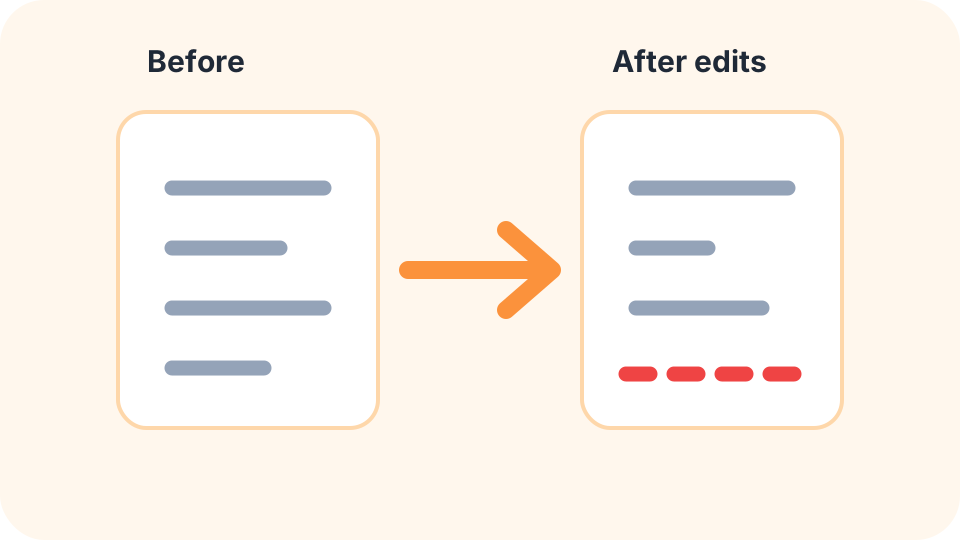
People often point to cropping, screenshots, compression, resizing, and re-saving as ways signals might disappear. Some signals are fragile. Plain metadata can vanish when a file is exported or posted to a platform. A signed C2PA manifest can be detached or invalidated by certain changes. Embedded watermark-style systems are designed differently and may survive some transformations better than metadata does.
None of that becomes a removal recipe. It simply explains why provenance checks must be read carefully. A file can lose a metadata field and still carry another signal. A screenshot can create a new file while preserving enough visual information for some checks and destroying other evidence. A compressed copy may be worse as evidence than the original, even if it looks almost the same to the eye.
If you want the technical background without evasion advice, read why AI watermarks survive some edits. The important point is that changing a file to defeat a check can also make the file less trustworthy. In professional settings, that may matter more than the original watermark.
You can also see this from the other side. Every export, resize, or re-save tends to leave small structural traces behind, and the photo tampering check reads those traces so you can tell when a copy has been rewritten. That is a useful clue about a file’s handling — and a reminder that quietly altering a file never leaves it looking untouched.
What to do when a watermark creates a workflow problem
If your issue is disclosure, the clean solution is not removal. Keep the provenance signal and explain it. If a file was generated or edited with an AI system, say that in the project notes, caption, license record, or delivery email. The wording can be simple: “This file may carry AI provenance signals from the generation or editing workflow.”
If your issue is an upload rejection, ask the platform or client what rule is being applied. They may want a different format, a rights statement, a source file, or a content disclosure. Removing a signal may not solve the real compliance question. It may also make you look less transparent if the file is reviewed later.
If your issue is uncertainty, check what can be checked. Use this site's browser tools for metadata and credentials, then use Google's official detector for SynthID-specific questions. The overview of what AI checks can detect can help you separate ordinary metadata, C2PA credentials, Stable Diffusion-related clues, and SynthID.
How to talk about a file without hiding the signal
Good provenance language is narrow and boring in the best way. Do not write “AI-free” because a checker found nothing. Do not write “fake” because one signal appeared. Write what happened: “The tested copy carries Content Credentials.” “The metadata includes an editing software field.” “Google's official tool should be used for SynthID.” “No relevant signal was found in this copy.”
That wording protects you from both overclaiming and under-disclosing. It also keeps the conversation focused on evidence instead of vibes. A watermark is not a moral verdict on the image. It is a provenance clue. Treat it that way.
So the answer to “can you remove a SynthID watermark?” is intentionally limited. We will not help remove it. We will help you understand which signals may be present, which tools are appropriate, and how to describe the result without pretending that absence equals innocence.
SynthID removal questions
Will you remove SynthID from my image?
No. We do not remove or bypass watermarks, and we do not provide instructions for defeating provenance systems.
Are online SynthID remover sites safe?
Treat them as a trust risk. They may overpromise, mishandle uploads, or test for something other than SynthID.
Can editing accidentally damage provenance signals?
Yes, some edits can remove or break some signals, but that does not make the edited file a stronger source of truth.
What should I do if a client asks for no watermark?
Clarify whether they need disclosure, licensing information, a different export, or an official check rather than hidden provenance.
If credibility is the goal, keep the evidence trail clearer than the minimum required.